
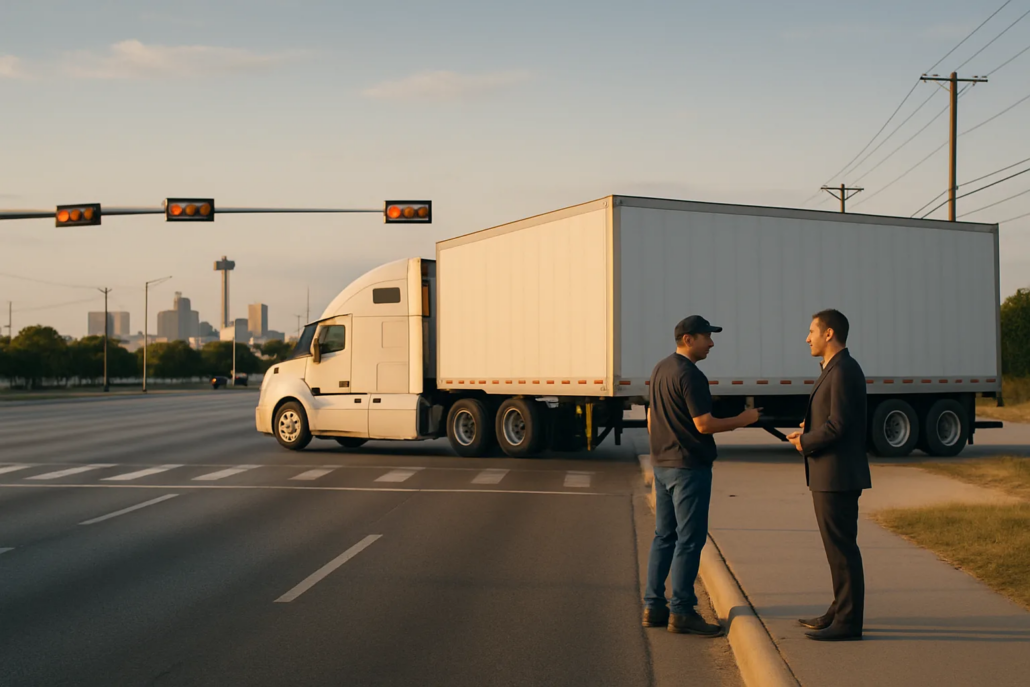
Why Can Texas Trucking Firms Face Liability for Drivers?
A commercial truck runs a red light, changes lanes unsafely, or follows too closely. The driver receives a citation and may even acknowledge the mistake. For an injured person in San Antonio, Texas, that can seem like the entire liability question is settled. It usually is not. Trucking company liability for driver negligence in Texas may depend on more than the driver’s conduct at the moment of impact. Husain Law helps readers understand how the carrier’s role may be evaluated, including dispatch decisions, supervision, training, maintenance, and insurance relationships. For additional context, review how a contractor label affects San Antonio truck liability. This article explains the difference between the driver’s direct negligence and separate claims against a trucking company, the evidence that may matter, and common issues after a commercial crash. For additional context on this issue, see What Evidence Should You Preserve After a San Antonio Crash?.
When Can a Trucking Company Share Liability for a Driver’s Violation?
A traffic ticket generally addresses whether the driver violated a rule or acted improperly. It does not automatically determine every party’s civil responsibility for injuries or property damage. In a Texas truck accident claim, the driver may be directly negligent, while the carrier may also face questions about its own conduct or its legal relationship with the driver.
Direct negligence and employer responsibility
A carrier may be responsible for an employee’s work-related conduct under general agency principles. The analysis can depend on whether the driver was acting within the scope of assigned duties and whether the company controlled the work. A carrier may also be evaluated separately for negligent hiring, training, supervision, retention, dispatching, or vehicle maintenance.
These are distinct theories. A driver’s failure to stop may support one part of a claim, while evidence of unrealistic delivery demands or inadequate training may support another. The facts must be developed rather than assumed from the citation alone.
Does the driver’s employment status change the analysis?
Companies sometimes describe drivers as independent contractors, owner-operators, or leased drivers. A label is not always the end of the inquiry. The contract, actual control, equipment ownership, dispatch relationship, and operational role may all matter when evaluating how a contractor label affects San Antonio truck liability. The answer can be fact-specific under Texas law.
What Company Conduct Can Add to a San Antonio Truck Accident Claim?
The central question is often whether the carrier contributed to the risk before the crash. A company may not be responsible simply because its name appears on the truck. However, company decisions can become important when they helped cause or worsen the collision.
Dispatch, scheduling, and supervision
Delivery schedules, dispatch messages, route assignments, and electronic logging information may show whether a driver was pressured to continue despite fatigue or unsafe conditions. These records may also reveal whether supervisors knew about repeated traffic violations, complaints, licensing concerns, or other warning signs. How driver logs can reveal fatigue in a San Antonio truck crash may be relevant when fatigue or scheduling pressure is part of the factual picture.
Hiring and training concerns
A carrier’s independent negligence may involve failing to investigate qualifications, assigning a driver without appropriate training, or ignoring known safety issues. The available evidence can include driver qualification materials, training records, prior disciplinary records, and internal safety policies. More information about negligent hiring and supervision after a San Antonio truck crash can help explain that distinction.
Vehicle assignment and maintenance
A carrier may also face questions if defective brakes, tires, lights, steering, or other equipment contributed to the crash. Maintenance schedules, inspection reports, repair orders, and out-of-service documentation can help establish whether the vehicle was reasonably maintained before it was assigned. Evidence about records showing whether poor truck maintenance contributed to a crash may therefore matter even when the driver received a traffic citation.
In San Antonio, collision reports from the San Antonio Police Department or another investigating agency may provide an initial account. Those reports are important, but they may not contain the carrier’s private employment, dispatch, electronic, or maintenance records.
What Evidence Can Show More Than the Driver’s Traffic Violation?
A citation or admission may help establish what the driver did. It may not explain why the event occurred, whether the company contributed to the conditions, or which entity’s insurance applies. Prompt preservation of evidence can be significant because electronic and physical records may not be retained indefinitely.
Potentially relevant materials can include:
- Crash reports, photographs, video, and witness information;
- Electronic control module or other vehicle data, when available;
- Electronic logging information and dispatch communications;
- Driver qualification, training, licensing, and disciplinary records;
- Inspection, maintenance, repair, and post-crash examination records; and
- Commercial policies, leases, corporate ownership records, and claims communications.
A San Antonio truck accident may involve the driver, motor carrier, vehicle owner, leasing company, maintenance provider, or another business. Identifying every potentially responsible entity can affect how a claim is evaluated and which policy limits may be relevant. Information about insurance coverage for a San Antonio commercial truck crash may help readers understand why the company named on the trailer is not always the only entity to investigate.
Common mistakes after a commercial crash
People may focus only on the ticket, assume the driver’s employer is automatically responsible, or discuss fault with an insurer before understanding the evidence. They may also overlook photographs of the roadway, vehicle damage, traffic signals, or visible company identifiers. In Bexar County and elsewhere in Texas, the applicable facts and legal deadlines can vary, so a careful review is generally more useful than relying on a single citation or early insurance position.
Frequently Asked Questions
Does a truck driver’s ticket prove the trucking company is liable?
Not by itself. A ticket may support evidence that the driver violated a traffic rule, but it does not automatically establish that the carrier was negligent or that the driver was acting within the scope of employment. Company liability may depend on additional facts involving control, dispatch, hiring, training, supervision, maintenance, and the driver’s relationship with the carrier. The effect of a citation can also depend on the surrounding evidence and applicable Texas law.
Can a trucking company deny responsibility if the driver is an independent contractor?
A contractor designation may be relevant, but it does not necessarily resolve the issue. Decision-makers may examine the written agreement, actual control over the work, dispatch practices, equipment, insurance, and the company’s operational role. Different legal theories may apply to vicarious responsibility and the company’s own negligence. In a San Antonio claim, the relationship should generally be evaluated using the complete factual record rather than a label alone.
What if the crash report blames only the truck driver?
An initial crash report can be useful, but it may address only the immediate collision facts. It may not include dispatch messages, electronic logs, driver qualification materials, maintenance records, or commercial insurance information. Additional evidence can raise separate questions about carrier conduct. A report is therefore one piece of the investigation, not necessarily a complete determination of every party’s civil liability.
Can multiple companies be involved in a truck accident claim?
Yes, depending on the facts. The driver, motor carrier, vehicle owner, leasing company, maintenance provider, or another business may have different roles. Their insurance arrangements may also differ. Determining which entities controlled the vehicle or driver, supplied services, or contributed to the crash can require contracts, records, and witness information. Texas law and the evidence available in the particular case will influence how responsibility is analyzed.
How Husain Law Can Help
Husain Law is dedicated to helping people understand the legal issues that can follow a commercial truck crash in San Antonio, Texas. The firm can evaluate how the driver’s conduct, the carrier’s practices, the vehicle’s condition, and the available insurance information fit together. That review may include identifying important records and distinguishing direct driver negligence from potential trucking company negligence. Husain Law is committed to fighting for clients’ rights while providing clear, practical information about available options. Contact the firm for a free consultation or case evaluation to discuss your situation.
The information in this article is for educational purposes only and does not constitute legal advice. Contact a qualified attorney licensed in San Antonio, Texas for advice specific to your situation.

Leave a Reply
Want to join the discussion?Feel free to contribute!