
What Shapes a San Antonio Underride Truck Accident Claim?
A collision between a passenger vehicle and an 18-wheeler may look straightforward at first: one vehicle struck another, and someone must determine who was responsible. But an underride or jackknife crash can involve a much more complicated sequence of braking, turning, trailer movement, visibility, and vehicle compatibility. For someone researching a San Antonio underride truck accident claim, the physical evidence may explain the crash more clearly than a quick description from the roadside. Husain Law helps readers understand why those details can matter.
Learn about the evidence to preserve after a San Antonio truck crash before vehicles are repaired, roadway marks disappear, or electronic information becomes harder to obtain. This article explains how underride and jackknife crashes differ from ordinary truck collisions, what investigators may examine, and how those findings can affect liability and insurance questions.
Why Are Underride and Jackknife Crashes Treated Differently in San Antonio Truck Accident Claims?
An ordinary rear-end or lane-change collision may still require careful investigation. An underride or jackknife collision, however, often produces a distinctive physical pattern that raises additional questions about how the tractor-trailer moved and whether safety equipment functioned as intended.
Understanding an underride collision
An underride occurs when a smaller vehicle slides partly or completely beneath a truck or trailer. The passenger vehicle may strike the rear or side of the trailer, while the truck’s higher frame passes over part of the smaller vehicle. The resulting damage pattern can be severe, and the location of the impact may help investigators evaluate trailer height, braking, visibility, relative speed, and the performance or presence of protective equipment.
Understanding a jackknife collision
A jackknife occurs when the tractor and trailer fold toward one another, often creating a sharply angled combination. Excessive braking, loss of traction, abrupt steering, cargo movement, equipment problems, or road conditions may be among the issues examined. Tire marks, yaw marks, final positions, and damage to multiple vehicles can help reconstruct whether the trailer crossed lanes or rotated after an initial loss of control.
In San Antonio, Texas, a crash reconstruction may need to account for traffic patterns, roadway grade, weather, construction, and the location of the collision. Those details can distinguish a simple impact from a chain of events involving several possible contributing factors.
What Evidence Can Explain an Underride or Jackknife Truck Crash?
The central question is often not just where the vehicles ended. Investigators may ask what happened during the seconds before impact, how quickly the truck was traveling, when braking began, whether the trailer was visible, and how the vehicles interacted during the collision.
Important evidence may include:
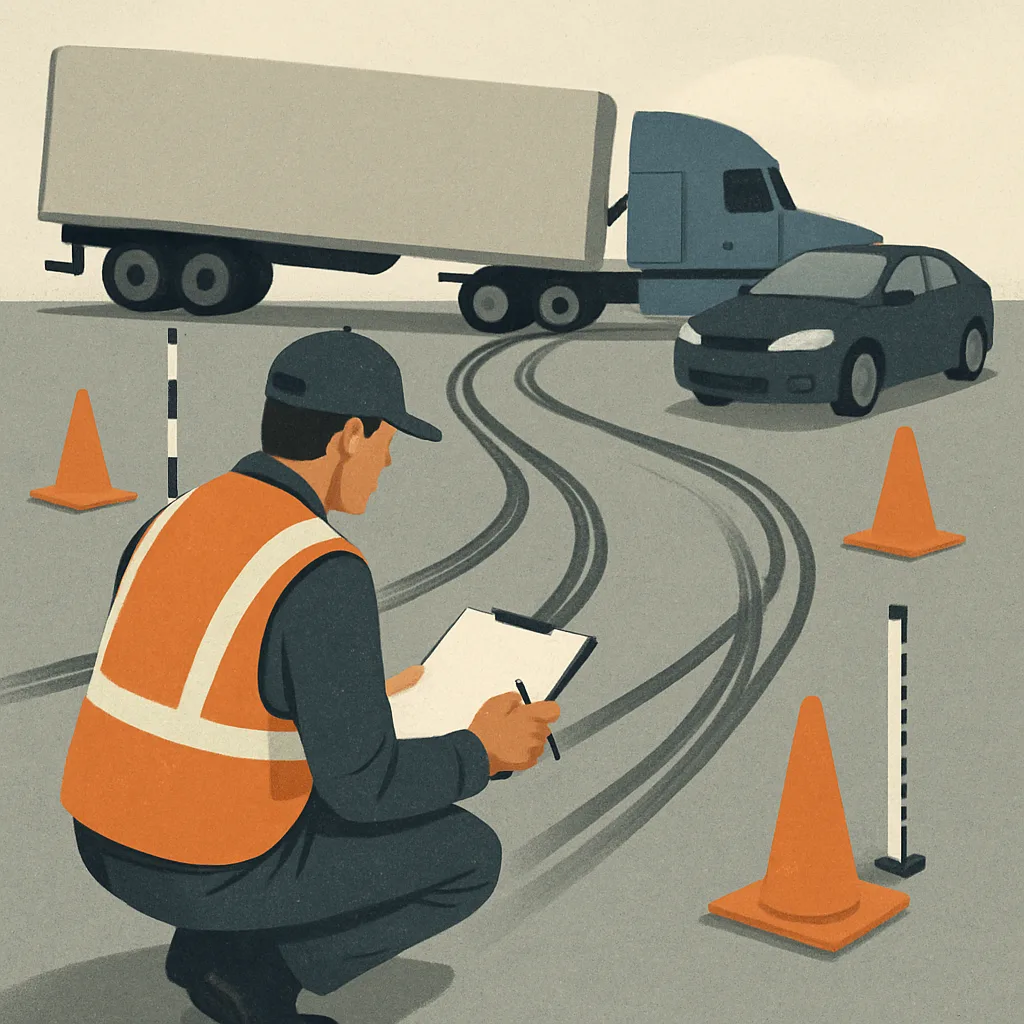
- Tire marks, gouges, debris fields, and final vehicle positions
- Damage height, crush patterns, underride marks, and trailer contact points
- Event data or other electronic information available from the truck or passenger vehicle
- Electronic logging data, dispatch communications, and driver schedules
- Dashcam, traffic-camera, nearby business, or witness video
- Inspection, repair, and maintenance records for brakes, tires, steering, lights, and underride guards
- Cargo loading records showing weight distribution or possible shifting freight
The condition of the truck can be especially important. Brake imbalance, worn tires, defective lighting, or steering problems may affect stopping distance, trailer control, or a driver’s ability to see and respond. Records showing whether poor truck maintenance contributed to the crash may help place physical evidence in context.
Cargo can also matter in a jackknife investigation. Uneven or unsecured freight may alter the trailer’s balance and movement. Depending on the evidence, questions may arise about when the cargo was loaded, who controlled the loading process, and when shippers or carriers may share liability for truck cargo.
A reconstruction does not automatically establish fault. It is one part of a broader investigation that may involve driver conduct, carrier practices, road conditions, equipment, and the actions of other motorists.
How Can Crash Mechanics Affect Liability and the Claim Process?
A distinctive crash pattern may lead to several potentially responsible parties and more than one insurance policy. A driver’s speed, following distance, lane position, braking, or steering may be relevant, but those issues may not answer whether a motor carrier, trailer owner, maintenance provider, shipper, or another entity also contributed.
For example, evidence may raise questions about:
- Whether the driver reacted appropriately to traffic or roadway conditions.
- Whether the carrier provided adequate training, supervision, or safety oversight.
- Whether maintenance issues affected braking, tires, lights, or steering.
- Whether cargo was loaded or secured in a way that affected trailer stability.
- Whether the trailer had appropriate visibility or underride protection for the circumstances.
A citation or preliminary reconstruction finding does not necessarily resolve every civil liability issue. Readers may benefit from understanding how Texas trucking firms may share liability for a driver’s conduct, while also recognizing that responsibility depends on the facts and applicable law.
The same evidence can affect insurance handling. A serious crash may involve coverage connected to the motor carrier, an owner-operator, a trailer owner, or other commercial entities. Identifying the insurance coverage involved in a San Antonio commercial truck crash can be important when the collision involves catastrophic injuries, multiple vehicles, or disputed responsibility.
Prompt investigation may matter because skid marks can fade, damaged vehicles can be repaired or removed, and electronic data may require preservation. Texas filing deadlines also limit the time available for certain claims. Anyone evaluating the Texas deadline for a San Antonio truck accident claim should consider that the time to investigate and the time to file are separate concerns.
If a fatality occurred, surviving relatives and the deceased person’s estate may have different legal interests. Understanding how Texas family and estate claims may differ after a fatal truck crash can help explain why the identity of the claimant and the nature of available damages require careful review.
Driver condition may be another part of the analysis. Hours-of-service records, rest patterns, electronic logs, and dispatch communications may help evaluate whether fatigue affected reaction time, speed control, lane position, or braking decisions. In some cases, investigators examine whether driver logs reveal fatigue in a San Antonio truck crash even when the visible damage initially suggests a mechanical problem.
What Should Crash Survivors Know Before Pursuing a Claim?
Crash survivors and families often receive early explanations based on limited information. A trailer may appear to have crossed a lane, or a passenger vehicle may show severe underride damage, but the full sequence may not be clear until vehicles, records, and roadway evidence are examined together.
Generally speaking, it can be useful to preserve photographs, medical records, vehicle information, witness contacts, insurance communications, and any available video. A person should avoid guessing about speed, fault, or the cause of the collision when speaking about an event that remains under investigation. Depending on the circumstances, an attorney may also evaluate whether preservation requests, vehicle inspections, or an independent reconstruction are appropriate.
In San Antonio, Texas, the location of the crash may affect which court has jurisdiction and how a civil case proceeds. A matter may involve Bexar County courts or another venue depending on the parties, claims, and procedural rules. Texas law can change, and legal issues may differ based on the facts, so a general online explanation cannot determine the value or viability of an individual claim.
A consultation may focus on questions such as:
- What vehicles and commercial entities were involved?
- Was the trailer visible before impact, and did its lighting or protective equipment matter?
- What do damage heights, tire marks, and final positions show?
- Could maintenance, cargo, fatigue, or road conditions have contributed?
- Which parties and insurance policies may need to be identified?
Frequently Asked Questions
Is an underride crash always the truck driver’s fault?
No. An underride collision may involve driver actions, trailer visibility, lighting, roadway conditions, vehicle compatibility, equipment condition, or the conduct of another motorist. The physical damage pattern can help investigators understand the sequence, but it does not by itself establish legal fault. In Texas, responsibility is determined from the available evidence and applicable legal standards. A qualified attorney can review the circumstances without assuming that the most visible vehicle damage answers every liability question.
Why do tire marks matter in a jackknife investigation?
Tire marks may help show when braking or steering occurred, whether a vehicle lost traction, and how the tractor and trailer moved before impact. Investigators may compare those marks with roadway grade, weather, vehicle damage, and final positions. Marks can fade or be altered by traffic and weather, so their reliability depends on documentation and interpretation. They are one piece of a reconstruction, not automatic proof of speed or fault.
Can a trailer owner or maintenance provider be involved in an underride claim?
Possibly. Depending on the facts, an investigation may examine who owned, operated, maintained, loaded, or controlled the truck and trailer. A failed light, tire, brake component, or protective device may raise different questions from a driver’s reaction to traffic. Whether another entity has legal responsibility depends on evidence, contracts, applicable Texas law, and the connection between the condition and the collision. Identifying every potentially relevant party can be important before claims are evaluated.
What if an underride or jackknife crash caused a death?
A fatal truck collision may involve claims brought by eligible surviving relatives and separate claims through the deceased person’s estate. These claims can involve different legal interests, damages, and procedural requirements under Texas law. The evidence may still include vehicle damage, scene measurements, electronic data, maintenance records, and witness accounts. Families may wish to obtain advice from a Texas-licensed attorney who can explain how the available claims may apply to their circumstances.
How Husain Law Can Help
Husain Law is dedicated to helping crash survivors and families understand the evidence behind serious commercial truck collisions. The firm can evaluate how damage patterns, braking evidence, trailer visibility, maintenance records, cargo information, driver condition, and scene measurements may fit together in a San Antonio case.
The team is committed to fighting for clients’ rights while recognizing that every investigation depends on its own facts. If you or a family member was involved in an underride or jackknife collision, contact Husain Law for a free consultation or case evaluation. The firm is ready to evaluate your situation and discuss your legal options.
The information in this article is for educational purposes only and does not constitute legal advice. Contact a qualified attorney licensed in San Antonio, Texas for advice specific to your situation.